And a tiny, five-pixel wide red cross is to blame

When Mark Morris and Chris Delay of Introversion Software began working on Prison Architect, they knew it was a game that would stir controversy. They never expected, however, that a simulator about the incarceration of cute, blobby humans had the potential to make them criminals themselves. Their crime? Displaying a tiny, five-pixel wide red cross on the hood of the ambulances and backpacks of paramedics. It might sound laughable, but it just so happens that those five pixels arranged just so are an internationally protected symbol.
Days before Christmas, Delay and Morris received a concerning email from the British Red Cross.
"My immediate reason for writing is that it has been brought to our attention that in your game ‘Prison Architect’ a red cross emblem is displayed on vehicles," it reads. "Those responsible may be unaware that use of the red cross emblem is restricted under the Geneva Conventions for the Protection of War Victims of 12 August 1949, and that unauthorised use of this sign in the United Kingdom is an offence under the Geneva Conventions Act 1957."
Delay and Morris didn't know it, but for years they had been breaking the law—a very serious sounding one at that. "We actually thought we were being spoofed by somebody and that this couldn't possibly be real," Delay tells me. But, to their amusement (and anger), it was.
Delay and Morris, like many of us, had made a common mistake. "In my mind that the red cross is the universal symbol for health packs and health add-ons—anything to do with healing in videogames," Delay says. "I'm sure there are red crosses on Doom health packs from 20 years ago." And while he's right about Doom, he was wrong about the red cross. 
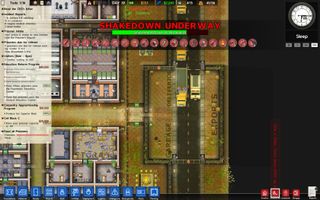
That tiny little red cross on the hood of the ambulance is where Delay and Morris went wrong.

More than just a health pack 

See, the red cross doesn't belong to the public domain. It's the protected emblem of the International Committee of the Red Cross (ICRC), an organization that dates back to the 1863. The ICRC was critical in establishing human rights during wartime as laid out in the Geneva Conventions that 196 countries have since agreed to abide by. For the average person, these conventions are usually understood as "don't harm prisoners, the wounded, and the people who are just trying to help them." For the ICRC and its various child-organizations around the world, that mission is a lot more complicated—especially when it comes to their emblem.
"The reason for this strict control is that the red cross emblem is an internationally agreed symbol of protection during armed conflicts," the email continues. "It is used to safeguard the wounded and sick and those who seek to help them in a totally neutral and impartial way, and can save lives."
Originally, laws prohibiting the misuse of the red cross emblem were used to prevent armed forces from exploiting it to gain a tactical advantage. In 2008, one such instance occurred when Colombian intelligence forces posed as members of the Red Cross to save political prisoners who had been held for years by FARC rebels. Doing so is a war crime. But is there really no difference between a tiny red cross on a videogame ambulance and one used to misrepresent military personnel in combat?
"If the red cross emblem or similar signs are used for other purposes, no matter how beneficial or inconsequential they may seem, the special significance of the emblem will be diminished," the email reads. "The red cross emblem or similar designs are not general signs of ambulances, health care, first aid, the nursing or medical profession, or similar matters. Moreover, they are not signs to be used for commercial purposes, such as for advertising campaigns or on products." 

Health packs in Halo: Combat Evolved used the red cross but were changed to a red 'H' for Halo 2.
Yet the use of the red cross for just those reasons is common. A Google search for 'health pack' returns dozens of results for everything from Doom to Halo. Outside of videogames, it appears in comic books, movies, and even theater. With misuse of the symbol so apparently widespread, Delay tells me he was a bit upset to find that Prison Architect had been one instance where the hammer would fall.
"Red crosses are such a minor five-pixel wide symbol in Prison Architect," he argues. "There's one on the ambulance and one on the back of a health pack. They are so tiny. I think it's ridiculous. It's not like we had these enormous red crosses everywhere on the sides of vans in war zones. It's this miniscule pixelated red cross you can barely make out."
But Introversion Software isn't the first developer to draw the attention of a Red Cross organization, either. In 2006, the David Pratt of the Canadian Red Cross sent a letter to a law firm representing several game developers urging them to stop using the symbol in their games. "Our philosophy is that there's no emblem abuse that's too small to report, because you have to try to get them all, which is a practically impossible task—but one thing we saw with the videogames industry is that it has a huge reach, especially with young people," Pratt said in an interview with Shacknews. "It may create an impression that the red cross emblem is part of the public domain."
On the surface, this sounds like a typical case of enforcing the misuse of a trademark—the kind that videogames have been dealing with for decades. Except that the Red Cross isn't a business where misuse of their logo might result in financial harm. According to an article published by the Canadian Red Cross, it's that misuse of the emblem could lead to physical harm. 
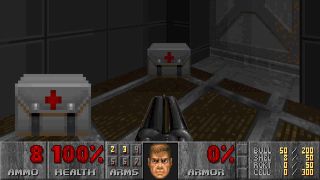
The red cross appeared in Doom but was later changed with the re-release to a red pill..
The real issue, at least where Delay and Morris live, seems to have more serious consequences than just being sued. In the United Kingdom, the provisions of the Geneva Conventions were incorporated into British law in 1957. Prison Architect's misuse of the emblem wasn't just breaking the Geneva Conventions (which feels kind of like some distant bogeyman), but the laws of their own country. That's why, upon getting the email, they were quick to comply. Boot up Prison Architect and call in some paramedics, and you'll no longer see that red cross. Now it's green. Delay tells me the change took seconds to make in Photoshop. "It's not worth taking the stand," Morris says. "You have to pick your battles." 

Drawing the line 

While both developers recognize that the red cross can be an important symbol in the right context, they can't help but raise their eyebrows at the fact that a charitable organization is spending its donated resources to cracking down on indie game developers.
"Lots of people donate money and the assumption is that that money is going to treating [people in need] and it turns out that a portion of that money is going to lawyers writing letters to videogame companies who are apparently abusing use of the red cross symbol," Morris says. "How much money do they spend every year enforcing their abuse of the red cross emblem? We are one videogame out of thousands, so many of which use that emblem to indicate health. Do they just cherry pick the odd person to approach? In which case, it would feel like a complete waste of time to spend any money at all, if you're not going to enforce it consistently. If they were spending large amounts of money to persistently and consistently enforce ownership of their red cross around the world in industries that are completely unrelated, is that a legitimate use of money for a charitable organization?"
Is the supposed dilution of the red cross' important meaning really of such importance? Internet activist, journalist, and author Cory Doctorow doesn't think so. "Is there any question that the use of red crosses to denote health packs in games will bring even the most minute quantum of harm to the Red Cross?" he wrote in a blog post criticizing Pratt's letter. Doctorow reached out to the Canadian Red Cross for comment and they appear to not have responded. 
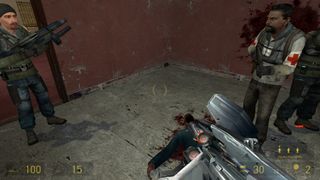
Medics in Half-Life 2 also bear the red cross.
On a broader spectrum, various Red Cross organizations have come under scrutiny for how they choose to spend their money and the lack of disclosurethat can sometimes go along with it. While there's no denying that the mission of the Red Cross is noble, how efficiently it goes about it is contentious. "When you're a charity, you need to talk about these things I think," Morris says. "People donate, and I really believe that you have an obligation to tell people where the money is spent."
For Morris, who tells me he's donated to the British Red Cross, the situation has an interesting wrinkle: Some tiny sliver of his own charitable givings has fueled the action taken against him. "I'm not saying I'm going to stop, but until I get some kind of understanding of how much of my money they're using to pursue infringement claims, I'm starting to think, maybe they've got a little bit more money than they need?"
For a game that has a history of spawning thought-provoking discussions, this latest development was never intended, but Morris and Delay see it as just another day at the office. "This is just the latest fascinating twist and turn. That's what's really interesting about it, Prison Architect gets people talking," Delay says. Now that the issue is settled, both developers are relatively good-humored about the experience.
"I think of myself giving an after dinner speech on my 70th birthday and talking about everything I've achieved in my life, and one of them will be my war criminal status," Morris jokes.
"That's not exactly a list you want to be on," Delay fires back.
But, among their jokes, one question still needs an answer: Is a little red cross really worth the trouble?
We've reached out to the British Red Cross for comment and will update this story should they reply. 

"16 years later, even if the visuals don’t hold up, the game definitely still does."


In the earliest Deus Ex design document, written three years before the game was released in 2000, Ion Storm established the philosophy of their ambitious cyberpunk RPG. “The key to role-playing is giving players the freedom to act as they see fit,” it reads. “And a deep world simulation that allows them to solve problems in a variety of ways is the best way to do this.” 
And that’s the core of what makes Deus Ex a PC classic. The sheer breadth of its systems and the complexity of its level design is unmatched, even today. A lot of things were cut from that document—including a level set on a space station—but Warren Spector and his team’s original vision of a deep, rewarding RPG set in a rich, simulated world remained intact throughout development. 
When Deus Ex was being developed, The X-Files was deep into its fourth season. And Chris Carter’s cult show is an obvious influence on the game, with its government conspiracies, shadowy secret organisations, men in black, and bug-eyed aliens. The design document confirms this, describing the story as “leavened by its dark, mysterious, conspiratorial tone” and any tinfoil hat conspiracy theory you can think of, from Area 51 to the Bilderberg Group, factors into the story in some way. It’s a world where paranoia about ancient secret societies pulling the strings of government is entirely justified.                                                                                                                                                 
In the ‘high concept’ section of the design document, Ion Storm asks: “Is it better to live free in a world of chaos or live safely in an ordered world of someone else’s design?” And that’s one of the major themes in the sprawling, labyrinthine story. You play as JC Denton, a government agent enhanced with augmentations that grant him superhuman powers. 
When the game begins he’s employed by a branch of the United Nations created in response to the growing threat of international terrorism. But after learning that his bosses have ties to a sinister Illuminati plot, he joins his brother Paul in the resistance against them. “Deus Ex plugs into two popular fantasies,” reads the document. “The millennial madness that’s gripping the world, exemplified by The X-Files and a general fascination with conspiracy theories. And the desire to play with high-tech espionage toys.”
And it’s these toys, as well as Denton’s augmentations, that makes every playthrough of Deus Ex a wildly different experience. The first level, Liberty Island, showcases everything that’s great about the game’s open-ended design and how it rewards creative thinking. It’s smaller than other levels, and I’m still finding new ways to infiltrate it. The statue not only provides a useful navigation point, but her missing head, blown off by terrorists, is an evocative piece of world-building. A clue that maybe everything isn’t totally cool in this dystopian vision of the future.                                   

Terrorists have taken over the island, and you have to deal with them. But how you go about this is truly up to you. There are dozens of entry points into the statue, some more dangerous than others. If you want to waltz in through the front door, you can. But you’ll have to find a key, hack a series of cameras, and deal with a security bot. Or you can stack crates to climb up to the statue and avoid the security systems altogether, but will have to deal with a group of terrorists in an open area without much cover. You learn these things through experimentation, and that’s part of what makes Deus Ex so compelling. You’re presented with these big, complex puzzles and the game leaves you to figure out how to solve them by yourself. And when you do, it’s hugely satisfying. 

Walk and talk 

But it’s not all espionage and infiltration. Outside of missions you’re free to explore, talk to NPCs, complete sidequests, and learn more about the state of the world through documents and news reports. Deus Ex is an enormous game, featuring three massive cities—New York, Hong Kong and Paris—and other locations including Area 51. You simply couldn’t make a game this big today with the visual fidelity expected of modern games. In New York you witness the devastating effects of the mysterious Grey Death virus, while in Hong Kong you team up with Tracer Tong and the Triads to investigate an Illuminati presence there. There are so many secrets hidden in these city hubs—and overwrought philosophical debates to be had with talkative NPCs – that a thorough playthrough of the game could easily take 50 hours. 
But while the levels are huge, they’re not big for the sake of it. This was another thing Ion Storm outlined in their design document as being important. “So many games simulate huge worlds and brag about it,” it reads. “Witness Daggerfall with its hundreds of generic towns, its shallow conversations, and its randomly generated quests. We feel there’s more to be gained by limiting the size of our simulation so we can increase the density of interaction.”


And this density of interaction is another of Deus Ex’s many strengths. Its levels are filled with things to prod, poke, switch on, and mess with—from incidental details like flushing toilets to intricate security systems that can be manipulated to help you sneak through the level. “This gives the illusion that this is a real, vital It’s all gone a bit X-Files. His vision is augmented. place,” reads the design document. “It makes the levels feel like they have a life of their own, independent of player action.” 
And it has a sense of humour too, often as a result of this freedom and interactivity. If you stumble into the ladies’ bathroom in UNATCO’s Liberty Island HQ – which most players will as they hunt for secrets and hidden items—your boss Joseph Manderley (who recently appeared in Mankind Divided) will give you a stern talking to about it. Ion Storm knew players like to explore every nook and cranny of a level, and they made a joke in response to it. 
It’s a small detail, but one of countless tiny reactive moments that reinforce the idea you’re having an impact on this world, not just existing in it. And who could forget mechanically-augmented agent Gunther Hermann ranting about getting the wrong soda from a vending machine, convinced the maintenance man has a vendetta against him. The story deals with some heavy stuff—mass surveillance, corruption, conspiracies, viral epidemics—but it offsets it nicely with some dry humour.

A great example of the game’s reactivity can be found in the Hell’s Kitchen level. Denton’s brother Paul, who ends up being hunted by the Illuminati, is holed up in a grimy hotel. It’s called the ‘Ton by the locals, referring to the fact it was once a Hilton, but the ‘HIL’ on the sign has faded away. After completing a few missions in New York, Paul’s safehouse is compromised and the Illuminati sends a squad of ‘men in black’ agents to kill him. 
These guys are armed with heavy weapons and can take a ridiculous amount of damage. Paul tells you to run and escape through the bathroom window, which most players will do when faced with these seemingly impossible odds. If you escape, Paul dies and never appears in the game again. But if you stay and fight, and somehow manage to kill the men in black and the UNATCO troops who’ve invaded the hotel, Paul will appear in Hong Kong. It’s unlikely that players at this stage in the game, especially on their first run, will have the skill or augmentations to win this fight, but the fact you can is precisely why Deus Ex is such a special game. It has a response, even if it’s just a line of dialogue, for almost everything you do. 

All mod cons

One part of Deus Ex that’s really showing its age though, is the visuals. It’s a hideous game, with blocky environments, blurry textures and ugly character models. But luckily there are mods that will sort most of these problems out, including the incredible Revision. This overhaul is free on Steam for anyone who owns the GOTY edition, and as well as fixing bugs and remixing several maps, it makes it look slightly nicer to modern eyes. But it does change quite a few fundamental things, so if you want to play the game as Ion Storm intended it’s probably best to stick to the original version. 
Then there’s Shifter, a mod that adds further depth to an already deep game and exists to, in its creator’s words, “remove the suck” from the the illuminati sends a squad of men in black to kill your brother base game. It introduces a skill point system that rewards you for feats the vanilla game would ignore, like taking out a room full of men in black. It makes enemies smarter and tougher. And it gives weapons alternate fire modes, including launching napalm bombs with the flamethrower. Again, installing this will seriously alter the game, so think carefully before trying it—especially if it’s your first playthrough. Some people don’t like Shifter or Revision at all, but that’s exactly what PC gaming, and Deus Ex, are all about: choice. 
The game is still totally playable without any mods, of course. But you might have to dig through some forums to find out how to get it running at modern resolutions. The Game of the Year edition (whatever that means) is often on sale for a tiny amount of money on Steam, so if you’ve never played it before, there’s really no excuse. 
There’s a long-running internet joke that whenever Deus Ex is mentioned on a forum, someone will reinstall it. And it’s something you should consider. Because 16 years later, even if the visuals don’t hold up, the game definitely still does.